|
NORTH CENTRAL TEXAS COLLEGE
COURSE SYLLABUS
|
|
|
Course Title:
|
Administrative Office procedures I
|
|
Course Prefix & Number:
|
POFT1309
|
Section Number:
|
340
|
Semester/Year:
|
171S
|
|
Semester Credit Hours:
|
3
|
Lecture Hours:
|
48
|
Lab Hours:
|
0
|
|
Course Description (NCTC Catalog):
Study of current office procedures, duties, and responsibilities applicable to an office environment.
|
|
Course Prerequisite(s): None
|
|
Required or Recommended Course Materials:
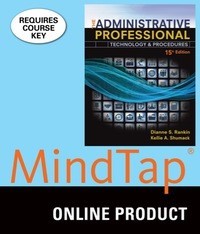
MindTap Course Code includes eBook: Rankin, Administrative Professional (LMS Intg MT Off Tech 1t 6m PAC) Cengage Learning 15th edition ISBN 9781305581210.
All POFI1309 Course materials/books can purchased at the NCTC Bookstore or directly online through CengageBrain.com
|
| |
|
|
|
|
|
|
INSTRUCTOR INFORMATION
|
Name of Instructor:
|
Dawn Dias
|
|
Campus/Office Location:
|
Corinth Campus, Room 313
|
|
Telephone Number:
|
940-498-6263
|
|
E-mail Address:
|
ddias@nctc.edu
|
OFFICE HOURS
|
Monday
|
Tuesday
|
Wednesday
|
Thursday
|
Friday
|
|
ONLINE
|
ONLINE
|
Room 313
|
Room 313
|
|
|
10am – 1pm
|
10am – 1pm
|
10am – 3pm
|
10am – 3pm
|
|
| |
STUDENT LEARNING OUTCOMES (From Academic Course Guide Manual/Workforce Education Course Manual/NCTC Catalog
|
At the successful completion of this course the student will be able to:
|
|
LO1
|
Develop time management techniques
|
|
LO2
|
Demonstrate communication skills
|
|
LO3
|
Identify the basic skills of an office professional
|
GRADING CRITERIA
|
# of Graded Course Elements
|
Graded Course Elements
|
Percentage or Point Values
|
|
29
|
MindTap Assignments
|
25%
|
|
13
|
Discussion Forums
|
25%
|
|
11
|
Quizzes
|
20%
|
|
5
|
Exams
|
30%
|
COURSE SUBJECT OUTLINE (Major Assignments, Due Dates, and Grading Criteria)
|
Entering the Workforce
|
Students will assess the demand for administrative professionals and describe their work and work settings, describe the skills, knowledge, attitudes, and traits employers expect of an administrative assistant, compare the responsibilities of the employer and employees in a work relationship, and describe the culture and structure of business organizations.
|
September 10
|
|
Becoming a Professional
|
Students will describe the qualities that makes a worker a professional, explain why critical-thinking, decision-making, and problem-solving skills are essential to an administrative assistant, describe how factors such as appearance, communication, and teamwork skills affect your professional image, and describe the importance of following business etiquette.
|
September 17
|
|
Managing and Organizing Yourself
|
Students will explain steps for setting and meeting goals and priorities, describe strategies and tools for organizing your work areas, describe strategies and tools for managing your workload, and identify life management skills that improve job performance.
|
September 24
|
|
EXAM I: The Workplace and You – DUE SEPTEMBER 27
|
|
Working Ethically
|
Students will describe basic ethical terms and concepts, list characteristics of ethical businesses and organizations, describe resources and methods for making ethical decisions at work, and identify unethical workplace behaviors and steps for working ethically.
|
October 1
|
|
Understanding the Workplace Team
|
Students will describe the benefits of tams and identify common types of workplace teams, describe and practice the general process by which teams operate, describe and utilize qualities and skills for being an effective team member, supporter, or leader, and list qualities of effective teams and identify team challenges.
|
October 8
|
|
Developing Customer Focus
|
Students will define customer focus, and explain the differences between external and internal customers, describe strategies for developing customer focus, develop skills for providing effective customer service, and describe how to handle difficult customer service situations.
|
October 15
|
|
EXAM II: The Workplace Environment – DUE OCTOBER 18
|
|
Communicating with Technology
|
Students will explain the value of global communication tools, describe the tools and methods used for collaborating in the workplace, describe effective techniques for telephone communication, and identify security issues and solutions for protecting computer data.
|
October 22
|
|
Planning Meetings and Events
|
Students will identify types of business meetings, identify appropriate meeting formats for various situations, describe meeting responsibilities of executives, leaders, and other participants, complete duties for an administrative assistant that are related to meetings and complete duties related to conferences.
|
October 29
|
|
EXAM III: Communication – The Key to Success – DUE NOVEMBER 1
|
|
Managing Electronic Records and Mail
|
Students will describe procedures for managing electronic records, prepare outgoing mail effectively, identify methods for sending outgoing mail, describe ways to handle incoming mail effectively, and describe how office printers and copiers are used in processing documents and records.
|
November 5
|
|
Coordinating Business Travel
|
Students will plan domestic travel arrangements, plan international travel arrangements, research business customs related to international travel, and discuss and apply organizational travel procedures.
|
November 12
|
|
Understanding Financial Documents
|
Students will describe financial statements for organizations, describe employee payroll deductions and prepare a payroll register, describe purchase transaction forms and procedures, and prepare a bank reconciliation.
|
November 19
|
|
EXAM IV: Records Management, Travel, and Finances – DUE NOVEMBER 22
|
|
Leading with Confidence
|
Students will describe differences in and theories of leadership and management, describe and develop qualities of effective leaders, describe common leadership styles, and describe and develop skills and strategies for successfully leading people.
|
December 3
|
|
FINAL EXAM – DUE December 11
|
ATTENDANCE POLICY
Regular and punctual attendance is expected of all students in all classes for which they have registered. All absences are considered to be unauthorized unless the student is absent due to illness or emergencies as determined by the instructor. It is the student responsibility to provide documentation as to the emergency for approval and judgement by the faculty member. Approved college sponsored activities are the only absences for which a student should not be held liable and only when provided by a college official ahead of the absence. Valid reasons for absence, however, do not relieve the student of the responsibility for making up required work. Students will not be allowed to make up an examination missed due to absence unless they have reasons acceptable to the instructor. A student who is compelled to be absent when a test is given should petition the instructor, in advance if possible, for permission to postpone the exam. Student will be dropped from a class by the Registrar upon recommendation of the instructor who feels the student has been justifiably absent or tardy a sufficient number of times to preclude meeting the course’s objectives. Persistent, unjustified absences from classes or laboratories will be considered sufficient cause for College officials to drop a student from the rolls of the College. From Board Policy FC (LOCAL)
Last day to withdraw from a course with a “W” is November 9, 2017.
COURSE ATTENDANCE POLICY:
In lieu of classroom attendance, the following will constitute the course attendance policy: Each student is expected to log in at least three times a week and complete weekly assignments to constitute regular attendance. Failure to log in for two successive weeks will be cause for concern and grounds to be dropped from the course. (Please note: A monitoring tool is available to the instructor. It monitors student log- in, providing dates, times and length of time online. This tool will be used to determine if students are logging in on a weekly basis.) Each week you will be asked to certify the work you completed, this too will be used to determine your attendance.
This online course requires dedication and effort on your part. You must set aside time each week to do your assignments. You should expect to spend 10 to 12 hours each week on this course. This may sound like a lot of time, but if you were taking this course in a traditional classroom, you would be in the classroom four hours a week with an additional nine to twelve hours spent on homework. It is very easy to fall behind, once the due date has passed, you will no longer be able to submit your assignments and quizzes will not be available.
Course Success Tip: Stay current in your work, log in often, check announcements for any special notices, and keep your personal information (email and phone number) up-to-date.
OTHER PERTINENT INFORMATION
- All course work is available via the Internet through NCTC’s CANVAS Learning Management System. Access CANVAS at https://nctc.instructure.com. Please go to https://nctc.instructure.com and bookmark (save to favorites) this site. It is not necessary to access CANVAS through the NCTC Website.
- It is the student’s responsibility to check the Course website and his or her course mail at least three times weekly.
- If a student should experience problems accessing the course material in CANVAS OR sending/receiving course mail, it is the student’s responsibility to notify the instructor immediately.
- Assignments are due on the assigned date. All weekly assignments are due before midnight on the following Sunday and due dates are clearly identified for each chapter in CANVAS. The instructor may not be available to answer questions from Friday after 12pm to 10am Monday. There will be no late assignments accepted period.
- Student data files may downloaded from the textbook publisher’s Website. See instructions on the Course homepage in CANVAS.
- Expect to spend 10 to 15 hours a week working in this course, the same amount of time it would take to attend and complete the assignments for an on-campus class.
- Assignments are due as posted. Students are required to complete 75% of all assignments and exams to receive a passing grade in this course.
- The instructor reserves the right to change course assignments, grading policies, and assignment schedules at any time.
- Emails will be answered within 24 hours Monday through noon on Friday. After noon on Friday through Sunday, they will be answered after 10am on Monday.
- Please use the assigned discussion forum to ask general questions about the course.
DISABILITY SERVICES (Office for Students with Disabilities)
The Office for Students with Disabilities (OSD) provides support services for students with disabilities, students enrolled in technical areas of study, and students who are classified as special populations (i.e. single parents).
Support services for students with disabilities might include appropriate and reasonable accommodations, or they may be in the form of personal counseling, academic counseling, career counseling, etc. Furthermore, OSD Counselors work with students to encourage self-advocacy and promote empowerment. The Counselors also provides resource information, disability-related information, and adaptive technology for students who qualify.
If you feel you have needs for services that the institution provides, please reach out to either Wayne Smith (940) 498-6207 or Yvonne Sandman (940) 668-4321. Alternative students may stop by Room 170 in Corinth or Room 110 in Gainesville.
CORE CURRICULUM FOUNDATIONAL COMPONENT AREA (For classes in the Core)________
o Communication
o Mathematics
o Life and Physical Science
o Language, Philosophy & Culture
o Creative Arts
o American History
o Government/Political Science
o Social and Behavioral Sciences
o Component Area Option
REQUIRED CORE OBJECTIVES (For classes in the Core)
o Critical Thinking
o Communication
o Empirical and Quantitative
o Teamwork
o Personal Responsibility
o Social Responsibility
COURSE TYPE
o Academic General Education Course (from ACGM but not in NCTC Core)
o Academic NCTC Core Curriculum Course
x WECM Course
STUDENT HANDBOOK
Students are expected to follow all rules and regulations found in the student handbook and published online.
ACADEMIC DISHONESTY
Scholastic dishonesty shall include, but is not limited to cheating, plagiarism, academic falsification, intellectual property dishonesty, academic dishonesty facilitation and collusion. Faculty members may document and bring charges against a student who is engaged in or is suspected to be engaged in academic dishonesty. See Student Handbook, “Student Rights & Responsibilities: Student Conduct Policy”.
Consequences for academic dishonesty may include:
- Academic Reprimand – A verbal or written notice warning to the student that academic misconduct has occurred.
- Assigning a failing grade (no credit) on the specific assignments, projects, papers, programs, labs, or examinations.
QUESTIONS, CONCERNS, or COMPLAINTS
|
Name of Chair/Coordinator:
|
Dr. Cherly Furdge, Division Chair
|
|
Office Location:
|
Corinth Campus, Room 234
|
|
Telephone Number:
|
940-498-6238
|
|
E-mail Address:
|
cfurdge@nctc.edu
|
|
Name of Instructional Dean:
|
Debbie Huffman
|
|
Office Location:
|
Gainesville, CTC2106
|
|
Telephone Number:
|
940-668-3357
|
|
E-mail Address:
|
dhuffman@nctc.edu
|