NORTH CENTRAL TEXAS COLLEGE
COURSE SYLLABUS
COURSE AND INSTRUCTOR INFORMATION
Course title: General Chemistry I
Course prefix, number, and section number: CHEM 1411.0401
Semester/Year of course: Fall 2025
Semester start and end dates: Aug 25, 2025 – Dec 13, 2025
Modality (Face to face/Synchronous or Asynchronous online/Hybrid): Face to face
Class meeting location, days, and times: Mondays and Wednesdays 3:30 – 4:50 pm in Corinth Rm 315
Lab meeting location, days, and times: Mondays 5:00 – 7:30 pm in Corinth Rm 363
Semester credit hours: 4 (48 hrs. lecture, 48 hrs. lab)
Course description: Fundamental principles of chemistry for majors in the sciences, health sciences, and engineering; topics include measurements, fundamental properties of matter, states of matter, chemical reactions, chemical stoichiometry, periodicity of elemental properties, atomic structure, chemical bonding, molecular structure, solutions, properties of gases, and an introduction to thermodynamics and descriptive chemistry.
Basic laboratory experiments supporting theoretical principles presented in lecture; introduction of the scientific method, experimental design, data collection and analysis, and preparation of laboratory reports.
Course prerequisites: MATH 1314 (College Algebra)
Required course materials:
- Textbook & Homework Access: Chemistry: A Molecular Approach (6th Edition) by Nivaldo J. Tro (Pearson). Access includes the eBook and online homework through Access Pearson in Canvas (MyLab & Mastering). You’ll need to purchase an access code (from the NCTC Bookstore or directly in through Access Pearson tab in Canvas). Have this set up by the end of Week 1.
- Scientific Calculator (non-graphing).
- Technology: Reliable internet, and a computer or tablet for homework and online tests (check with your instructor for alternatives). Ensure Java and Adobe Flash Player are installed if required.
Name of instructor: Dr. Pooja Ahuja
Office location: COR 333
Telephone number: 940-668-6232
E-mail address: pahuja@nctc.edu
Office hours for students:
Monday 12:20 – 3:20 pm (on campus, COR Rm 333)
Tuesday 12:30 – 2:30 pm (virtual through Webex, appointment required)
Wednesday 5:30 – 7:30 pm (virtual through Webex, appointment required)
SYLLABUS CHANGE DISCLAIMER
The faculty member reserves the right to make changes to this published syllabus if it is in the best interest of the educational development of this class. Any such changes will be announced as soon as possible in person and/or writing in Canvas.
SUMMARY OF COURSE ASSIGNMENTS
List of graded assignments: 3 Major Exams 40%
Lab Reports 20%
Homework and Quizzes 20%
Final Exam 20%
Final grade scale: A = 90-100% B = 80-89% C = 70-79% D = 60–69% F = <60%
CHECK CANVAS FOR WEEKLY LECTURE AND LAB SCHEDULE, COURSE ORIENTATION, DETAILED DESCRIPTION OF GRADED WORK, OTHER RELATED MATERIAL AND POLICIES.
COURSE POLICIES
Attendance Policy:
- Attendance will be taken at the beginning of each class. You are expected to attend class regularly and punctually. Students who are tardy or absent in chemistry class usually find it very difficult to keep up. Do not fall behind. If you miss class, it is your responsibility to catch up.
- All absences are considered to be unauthorized unless the student is absent due to illness or emergencies as determined by the instructor. It is the student responsibility to provide documentation as to the emergency for approval and judgement by the faculty member. Valid reasons for absence, however, do not relieve the student of the responsibility for making up required work.
- Excessive absences may result in a student being dropped from the course with no credit awarded. Excessive absences will be defined as more than 2 consecutive weeks.
- A student who enrolls in this course and fails to attend must drop the course to avoid receiving an “F”. Students may or may not be dropped automatically.
Exams and Quizzes Policy: Scheduled assessments will begin promptly on the scheduled dates per ‘Lecture and Lab schedule’ posted in canvas, in the beginning of the assigned class time.
- Quizzes and exams may be administered either on paper or online. For online, you will complete them in class using your device, such as a tablet or laptop with ‘Respondus Lockdown Browser’ installed. Click here for install instructions
- Alternatively, an online exam or quiz can be taken at the testing center or on paper (must be discussed at least 2 weeks prior to scheduled exam)
- Complete the practice quiz in canvas at least one week before EVERY exam to ensure Lockdown Browser works properly on your testing device. This gives you time to resolve any issues with IT/eLearning before the actual exam.
- Scheduled exams will begin promptly the beginning of the assigned class time. While there may be instances when being late is unavoidable, no over-time can or will be permitted for test-taking. Often times, there is a class after us.
- You will not be allowed to leave the room during an exam.
- No cell phones are allowed during exams or quizzes. If yours rings during an exam, your paper will be taken up immediately and your grade will suffer accordingly.
- Make-up exams are generally not allowed. In rare, extenuating circumstances, you may be eligible for a make-up exam if you contact me no later than 2 hours before the scheduled exam start time (for example, if your exam is at 2:00 PM, you must notify me by 12:00 PM). Documentation will be required to verify extenuating circumstances, such as emergency hospitalizations. Please note that issues like car troubles, traffic delays, routine doctor visits, and travel do not qualify as valid reasons for missing or requesting an extension or make-up exam.
- If the student is approved for the make-up, it must be completed within 2 days of the original exam date
- You are responsible for scheduling the make-up exam at the NCTC testing center and inform me of your appointment at least 24 hours prior, so I can complete the required paperwork and make the exam available for you. Space is limited; so, don’t wait! If you are not able to make an appointment, you must take a zero for a missed exam
- The makeup exam may be in a different format from the original exam. No more than one exam can be made-up during the course. If it is not possible to make up the exam, then a zero will be recorded.
- Quizzes are typically graded and returned on the same day they are administered and cannot be made up
- To allow for unexpected situations, your lowest lab grade and lowest homework grade will be dropped at the end of the semester.
- OSD TESTING: You will have at least 5 days’ notice before an exam to schedule extended time in the testing center. Your exam should be taken on the same day and around the same time as the rest of the class, or EARLIER. Be sure to keep in mind lab times if your exam falls on lab day. If this occurs, you must start early in order to take advantage of extended testing time and avoid missing lab (zero). Make your appointment ASAP to avoid conflicts and get the appointment time you need. YOU MUST EMAIL ME at least 24 hours in advance of the scheduled exam to get approval for your exam time.
- The final exam is a required exam for the completion of this course and is COMPREHENSIVE (covering all material in this course). The final exam grade cannot be replaced or dropped and is NOT optional
Online Homework Policy:
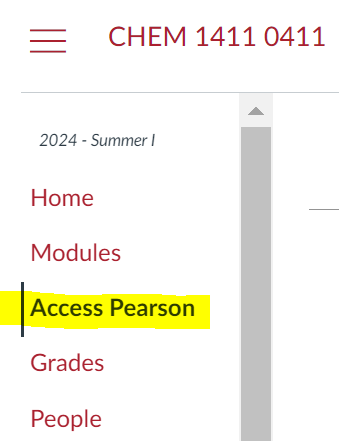 All homework must be completed through the ‘Access Pearson’ tab found on the left navigation panel in Canvas course page shown below.
 - Please use your full name when enrolling in the course homework for grades to sync with canvas correctly.
- Homework (HW) assignments will be available for at least 5 days and must be completed by the due date to avoid 5%-point penalty per day for late submission. NO EXTENSION OR MAKEUP will be given so plan accordingly.
- Any assignments due during the last week of class (the week before finals) must be submitted by the specified due date. Late submission will not be accepted during finals week, so be sure to complete these assignments on time.
- The hints feature in Pearson HW is free to use. You ARE penalized a very small amount for multiple attempts on one question, so don’t just keep guessing.
- Homework assignments are available for several days - manage your time wisely and leave enough time to deal with any computer problems that might arise and keep you from submitting your work in time. Submitting early is the best rule of thumb. Be aware that during peak times, the Mastering Chemistry website may run slowly so do not wait until the last minute
Extra Credit Policy: There will be some extra credit questions on the quizzes and exams, no other extra credit opportunities exist in this class
Late Work Policy: Assignments are expected to be turned in on the due date as stated on Canvas or in class. After that time, no late work will be accepted nor credit given for.
Grades Policy: It is your responsibility to check your grades in Canvas weekly to ensure they are posted correctly. Any discrepancies should be reported immediately —do not wait until the end of the semester, so they can be addressed promptly. Late grade discrepancies or disputes will not be entertained, so it is crucial that you check your grades regularly and report any discrepancies as soon as they arise.
The averages calculated on Canvas may or may not reflect your actual grade. Until an actual grade is recorded for each type of assignment, the average calculated will be incorrect. Refer to the syllabus above for the percentages for calculating your grade.
Lab Policy: Labs are worth 100 points (30 prelab, 40 lab report, 30 post-lab). Your one lowest lab grade will be dropped. No make-up possible. Student must pass the lab component of the course to receive a passing grade (D or higher) in the overall course. Refer to lab syllabus for details
Cell phones and technology Policy:
- These devices must be turned off or silent during class. If you must take a call during class for emergency reasons, quietly excuse yourself and step out of the classroom before taking the call.
- Use of any electronic device to access the internet during class is not recommended. Use of electronic devices are permitted for the purposes of taking notes and completing assignments only. If any distracting or disrespectful use by these devices or the student is suspected, you may be asked to leave for the remainder of the class session.
Other Student Responsibilities:
- Students are required to have access to a computer. A cell phone only, will not allow you to meet the requirements of this course. If you do not have a computer, you will need to go to an NCTC campus or local library as required to complete assignments etc.
- Log in Early each week and begin completing weekly assignments/requirements.
- Ask questions if you have them--Meet with me during office hours or Set up a WebEx meeting.
- Seek tutoring if needed. Tutoring is free to NCTC students and the schedule will be posted in course canvas, as soon its available
- Drop the course if you do not wish to or cannot complete the course
- Announcements: It is very important that students read all announcements in full. Students are encouraged to set the notifications to receive announcements as they are posted.
- To ensure a response from me, students should email me through Canvas ‘Message me’. I give priority to Canvas email over regular NCTC email as I know only students are emailing me in Canvas.
- Students are not to give any other person access to his/her Canvas account. Students can be removed from the course immediately up violating this rule. Once a student has given another person access to his/her canvas account, the credibility of any work completed becomes questionable.
Academic Integrity Policy: Scholastic dishonesty shall include, but is not limited to cheating, plagiarism, academic falsification, intellectual property dishonesty, academic dishonesty facilitation and collusion. Faculty members may document and bring charges against a student who is engaged in or is suspected to be engaged in academic dishonesty.
Honesty in completing assignments is essential. Cheating, plagiarism, or any other kind of academic dishonesty on any assignment will not be tolerated and will result in appropriate sanctions that may include failing an assignment or exam, failing the class, or suspension or expulsion. A report WILL be filed with the college. Consequences for academic dishonesty include that a grade of zero (“0”) on any assignment that might otherwise be eligible to be dropped (lowest lab or homework grade, etc) shall forfeit the right to said privilege. The zero shall stand and will count as part of the grade calculation. This includes an exam grade or final exam grade as well.
If cheating or collusion is suspected, a conference between the suspected parties, the instructor, and the appropriate dean will be scheduled and notation made in the student’s file.
Artificial Intelligence Policy: This course assumes that all work submitted by students will be generated by the students themselves, working individually or in groups. Students should not have another person/entity do the writing of any substantive portion of an assignment for them, which includes hiring a person or a company to write assignments and using artificial intelligence tools.
The instructor also retains the right to dismiss any student who exhibits verbal or nonverbal behavior that is distracting or disruptive to the learning environment.
Withdrawal Policy
A student may withdraw from a course on or after the official date of record. It is the student’s responsibility to initiate and complete a Withdrawal Request Form.
Last day to withdraw from the course with a “W” is: Nov 3, 2025
Student Learning Outcomes:
Lecture Learning Outcomes
- Define the fundamental properties of matter.
- Classify matter, compounds, and chemical reactions.
- Determine the basic nuclear and electronic structure of atoms.
- Identify trends in chemical and physical properties of the elements using the Periodic Table.
- Describe the bonding in and the shape of simple molecules and ions.
- Solve stoichiometric problems.
- Write chemical formulas.
- Write and balance equations.
- Use the rules of nomenclature to name chemical compounds.
- Define the types and characteristics of chemical reactions.
- Use the gas laws and basics of the Kinetic Molecular Theory to solve gas problems.
- Determine the role of energy in physical changes and chemical reactions.
- Convert units of measure and demonstrate dimensional analysis skills.
Lab Learning Outcomes
Upon successful completion of this course, students will:
- Use basic apparatus and apply experimental methodologies used in the chemistry laboratory.
- Demonstrate safe and proper handling of laboratory equipment and chemicals.
- Conduct basic laboratory experiments with proper laboratory techniques.
- Make careful and accurate experimental observations.
- Relate physical observations and measurements to theoretical principles.
- Interpret laboratory results and experimental data, and reach logical conclusions.
- Record experimental work completely and accurately in laboratory notebooks and communicate experimental results clearly in written reports.
- Design fundamental experiments involving principles of chemistry and chemical instrumentation.
- Identify appropriate sources of information for conducting laboratory experiments involving principles of chemistry.
Core Objectives:
Critical Thinking
Communication
Teamwork
Empirical and Quantitative Analysis
COLLEGE POLICIES
STUDENT HANDBOOK
Students are expected to follow all rules and regulations found in the Student Handbook.
ADA STATEMENT
NCTC will adhere to all applicable federal, state and local laws, regulations and guidelines with respect to providing reasonable accommodations to afford equal educational opportunity. It is the student’s responsibility to contact the Office for Students with Disabilities to arrange appropriate accommodations. See the OSD Syllabus Addendum.
AI STATEMENT
Absent a clear statement from a course instructor, use of or consultation with generative Artificial Intelligence (AI) or other similar technologies shall be treated analogously to assistance from another person, agency, or entity. In particular, using generative AI tools to substantially complete an assignment or exam is not permitted. Students should acknowledge the use of generative AI (other than incidental use) and default to disclosing such assistance when in doubt.
When students use generative AI to replace the rigorous demands of personal engagement with their coursework, it runs counter to the educational mission of the college and undermines the heart of education itself. Artificial Intelligence, large language models, and technologies hold promise for deploying knowledge in service to others and accelerating the discovery of new knowledge. However, such technology poses new challenges to pedagogy and to integrity. Within the context of the teaching mission of the college and consistent with the Student Code of Conduct, the authority to define the appropriate use, study, and deployment of these technologies rests with the faculty.
Individual course instructors, in coordination with their divisions, set policies regulating the use of generative AI tools in their courses, including allowing or disallowing some or all uses of such tools. Course instructors will set such policies in their course syllabi and clearly communicate such policies to students. Students who are unsure of policies regarding generative AI tools are encouraged to ask their instructors for clarification.
STUDENT SERVICES
NCTC provides a multitude of services and resources to support students. See the Student Services Syllabus Addendum for a listing of those departments and links to their sites.
QUESTIONS, CONCERNS, or COMPLAINTS
If you have any questions, concerns, or complaints regarding the class, your first step should be to contact the instructor directly to discuss the issue. If you and the instructor are unable to resolve the matter, you may then contact the chair or coordinator of the division, after discussing with the instructor of your dissatisfaction before reaching out. If the issue remains unresolved after speaking with the division chair or coordinator, you may contact the instructional dean for further assistance.
Name of Chair/Coordinator: Jaime Noles
Office location: Gainesville 408
Telephone number: 940-668-7731 ext. 4930
E-mail address: jnoles@nctc.edu
Name of Instructional Dean: Mary Martinson
Office location: Gainesville 1403
Telephone number: 940-668-7731 ext. 4377
E-mail address: mmartinson@nctc.edu